Saturday, November 12, 2022

What's It Like To Get Hearing Aids (After Being Hearing Impaired Most Of Your Life)?

When I see videos of infant children being given the ability to hear for the first time, I'm overjoyed like everyone else. Given that chance in my own experience, I've had mixed feelings. 

I wrote elsewhere that I am hard of hearing since birth. I lived in an aural landscape that was varied and rich enough to me, but nowhere near the full set of sounds available to the rest of the planet. I had no sense of the difference; I only knew that I could not hear some things and had trouble understanding some people. I accepted it no more than any person accepts that they can't fly. But it did shape my personality and relationships, causing me to be introverted and independent and others were at least amused by my hearing everything as a mondegreen or at worst frustrated with my constant misunderstandings.

After an ultimatum from my wife - and saving money in my HSA - I got my first pair of hearing aids in the fall of 2019. A world of sounds and understanding immediately became available to me, along with sensory overload. Getting hearing aids is not as simple as turning the volume to 11 and rocking on. 

My audiologist, Dr. Tracey Creswell, warned me of as much. She explained that my mind would need to become accustomed to this, and in time I would learn to sort out the sonic assault she unleashed on me. After a few months, she told me, I would start to make sense of all the new information being made available to me. Hearing is as much a neurological phenomenon as it is a physiological one. 

Immediately after she put them in my ears for the first time, I could hear a clock ticking. The hiss of the HVAC, undetermined hums, clicks, etc. A taste of what was to come. She told me that I would be bewildered at times and probably the best advice she gave me aside from this warning was to ask people from time time, "what's that noise?" so I could learn. I left for work from her office. 

Immediately upon walking outside, I was hit with a manifold increase in new sounds - the hiss of cars on the Taconic State Parkway, the sound of a single leaf skittering across the parking lot, a distant car radio. Getting into the car and turning the ignition I heard the ignition beeps and turn signal clicks for the first time. I had learned about these things and even installed the devices that make them in older cars  - but never heard them. I have driven for leagues on highways with a perpetual right hand turn signal before I discovered it. 

Then came the first unknown. Something was rattling in the car. Where was it? Was something loose? About to fail? What did this mean? I had no one to ask and I had to pull on into a parking lot to discover it was a small Nerf gun in the plastic cup holder of a door. 

Later at work I noticed I could hear noises and indicators that other people had long learned to ignore - the sound of the badge reader accepting my badge (thankfully), or the microwave indicating it is done with it's program. I heard a colleague talking 100' or more, down the hall. The clacking of keyboards - through walls. Distant phones ringing. 


Friday, May 10, 2019

Just one word, Benjamin.

In line at the grocery after work, circa 1990, cashier asks man ahead of me - about 45 years old - "paper or plastic?" He responds, "Plastic! of course!" and looks at me as if I get him because I had my IBM Badge still hanging off my shirt pocket or maybe I was wearing a tie. I smiled. As the cashier rings him up, I said, "That reminds me of a scene from the movie The Graduate. Are you familiar with it?" "Yes," he says, proudly, "It's why I got into the business!" Again, looks at me like I get the joke. The cashier looks at both of us suspiciously. She finishes his order, he fiddles with his bags and change at the end of the counter, and she asks me - "Paper or plastic?" I proudly responded, "Paper, of course." The man walks away glaring at me over his shoulder.

Monday, April 30, 2018

Day 30: Thanks

I am grateful for a lot of things this month.
I learned a lot these last three and a half years - from many of you, and from people in the autism at work community. I'd like to thank a few of you:
I once heard an expression, "If you are the smartest person in the room, you're in the wrong room." I assure you that throughout my entire career, through meeting all of you and more, I have been in the right room all along.

Day 29: Acceptance Means

I’m a day late, but I will get this and one more in before the month closes.

To me, acceptance means:
  • We can keep researching autism but not try to 'cure' autistic people
  • Parents don't fear autism but get the early intervention needed
  • Teachers don’t make fun of autistic kids…
  • …so kids don’t make fun of autistic kids…
  • …and kids treat each other better…
  • …and autistic kids go to prom…or whatever they want to do
  • Colleges work hard to recognize and develop their talent
  • Employers tap that talent and develop it and get better managers and employee morale
  • Retail establishments make their places of business autism friendly
  • Neighbors help one another raise the kids in their neighborhood and treat autistic adults well
  • Families help each other
  • And one day, we don’t need Autism Awareness month, because writing a blog post a day is hard work!

: )

Saturday, April 28, 2018

Day 28: Famous Autistic People

I've seen a lot of articles written about famous people who may be autistic, like this one. They're pretty cool, but in some cases they rely on speculation because they say a person long dead was autistic. People have said that about many people in history, including Thomas Jefferson, because of the way they were described by others.

My two favorite famous autistic people are Temple Grandin and John Elder Robison. Both have remarkable and different stories about how they dealt with and learned to embrace their autism. Temple Grandin's mother worked very hard to ensure she got the best care and was able to get through school and go on to college. She's now a famous author and has had a movie written about her life, starring Claire Danes.

John Elder Robison's life was a lot different. He was never diagnosed until much older, long after he quit high school, worked for KISS and Milton Bradley, and made his mark in numerous other ways.

Both Robison and Grandin speak at conferences or have done TED talks that are very inspiring.

Day 27: Meltdowns

I gotta confess, I know very little about this topic except what I have read. Autistic persons are often very sensitive to certain things - lights, noise, smells - even foods and clothing or other tactile issues. As such, the can get very overwhelmed with a lot of sensory input that the rest of us can ignore for the most part.
Here is a video that attempts to simulate what the feeling of sensory overload is like: https://www.youtube.com/watch?v=Lr4_dOorquQ&sns=em
What happens when you get too much sensory overload? Well, think about being tired, irritable, and generally overloaded with a lot of responsibility and you have five kids screaming and running around the house, four cats begging to be fed, a dog that needs to be walked, and a parrot that won't stop squawking. You're doing just fine, but then the smoke alarm goes off because your husband left the oven on and the pizza is burning. At that point, you want to just curl up into a ball because you've pretty much had it. Calgon, take me away!
You just want FIVE MINUTES AWAY from all this and you can't find it. That's a meltdown.
Meltdowns are NOT tantrums. Tantrums are when a child tries to get their way by crying or throwing a fit to see if that behavior will get them what they want. A meltdown is a reaction to overstimulation. The reason I bring that up is because you may see a child having a meltdown in public and confuse it with a tantrum and then give the evil sideye to the parents.
I've never seen a meltdown - not that I know of - But what I have read is that they may strike out or some curl up into a ball. Knowing that the environment you are in could cause a meltdown and watching for the signs of one (increased pacing, perhaps, or started looks and nervousness) can give you a clue that one is coming and you can head it off by giving the person down time.

Final day of Autism At Work Summit 2018

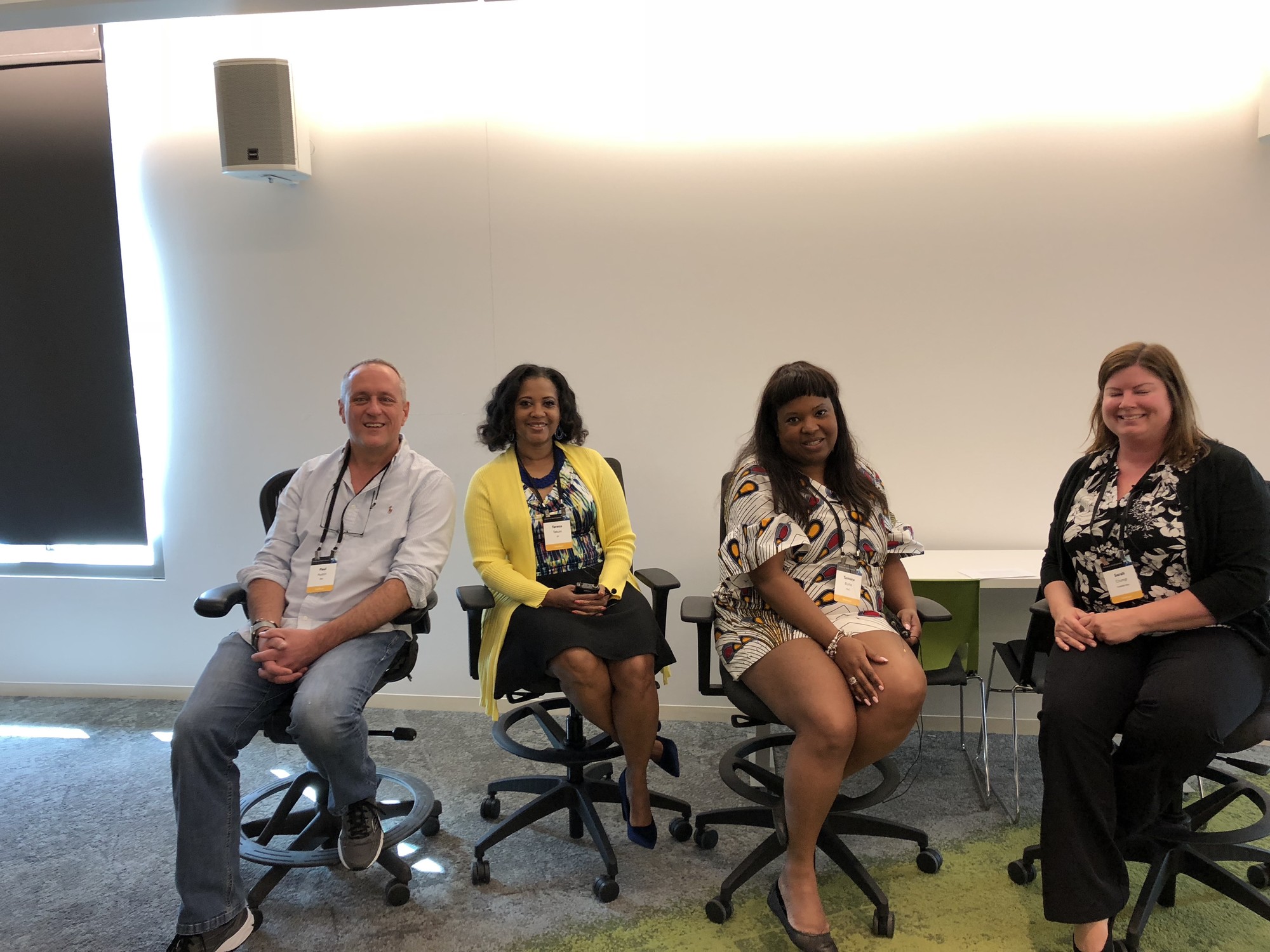
(LtoR: Paul Austin, IBM; Teresa Tatum, EY; Tamara Burks, PWC; Sarah Crump, Freddie Mac)

The last day of the summit started off with a video from NBC about Ford Motor Company’s hiring program. Notable in the video was the pride in the new engineer’s job with the complexity of his work and the relief his mother felt at his son finally being hired with a satisfying job. The NBC announcer concluded with a neat twist on Ford’s motto: “Inclusion is job one.” Autism Alliance of Michigan was instrumental in helping Ford start their program.

The first speaker of the day was Holly Robinson Peete. She is an actress, singer, reality TV star, husband of NFL player Rodney Peete and the daughter of Matt Robinson (who played Gordon on Sesame Street) and most importantly, the mother of an autistic young man.

Her family life is the subject of a Hallmark TV reality series, “For Peete’s Sake”. She showed some clips from the show, including one in which she reviews pictures of her son from a modeling shoot. He is a striking young man at age 21.

Peete calls the day her son was diagnosed with autism “Never Day”. That was the day she was told her son would never speak to anyone, never get a job, never say, “I love you” to his mother. She then showed us a video, narrated by her son, in which he would say, “The doctors said I would never do _____ “, repeatedly, and ending the sentence with different actions each time but always punctuating with an exclamatory “WRONG” as the video showed him doing the action.

Peete and her family started the HollyRod foundation to support Parkinson’s research because of her father, but later expanded their scope to include autism.

In addition to videos of her son in a modeling shoot, there were those of him working as a bat boy for the LA Dodgers and giving speeches – another thing he was told he would never do, much less speak at all.

She was a very energetic speaker who repeatedly praised the companies there working to hire people on the spectrum. During the Q&A session she was brought to tears by a woman who explained that Peete’s book, “My Brother Charlie,” and work were very inspirational to her family.

Panel discussions started up after that. The first one that I attended was about the first year of employment.

SAP’s Jose Velasco was first to speak, stressing the importance of keeping local partnerships with groups like The Arc, with whom they frequently partner in the cities in which SAP works. Velasco also stressed the importance of teaming with the government vocational rehabilitation programs. He also talked about the crown jewel that ensured the success of the employee for the first year – a support circle that included a job buddy, a mentor inside the company but outside of the immediate job, and a community support buddy outside the company.

Ford Motor Company’s Meeta Huggins was next, explaining their small pilot that resulted in four people being hired. They relied heavily on Autism Alliance of Michigan. Huggins stressed the importance of AAOM’s robust process, in which their staff come in and learn the jobs that the candidates are being interviewed for and suggest improvements and structure to the jobs to accommodate persons on the spectrum.

EY’s Hiren Shukla talked about the geographical variances in setting up their program. There are different NGOs in every different state they operate, and in some cases there are no local NGOs that can help them as The Arc does in other places, so they forge their own path following what they have learned.

Shukla stressed the need to convince the stakeholders in the hiring program to change management and process practices permanently and across the company for all employees because – as if often repeated in these summits – the accommodations that are good for autistic employees are good for all employees, increase morale and job satisfaction, and make better managers and coworkers.

All the panelists spoke about or agreed on this idea and offered examples such as making explicit such information that we assume everyone else knows or can just figure out on their own, such as:
·     Suggesting how to process email queues
·     What company or industry acronyms mean
·     Where to find Information about corporate policies

Each of the panelists also stressed that when vetting candidates, you often don’t get a great resume because of lack of practical experience that we look for in neurotypical people. You might not find an internship, for example. So, you try to draw out of them other examples of what they have done to demonstrate leadership – being an Eagle Scout, for example, or moderating a video game platform.

Two great questions came up during this session. First: What is the right amount of staffing to devote to this? Jose said that at first the program was created with no central leader and run by volunteers helping the recruiters and HR – becoming buddies or mentors. It was not until the program was about a year old that he was selected to be its leader full-time. Ford’s Huggins said she is expected to process this as part of her day job. EY’s Shukla said roughly the same.

Second, Colleen Allen of Autism Alliance of Michigan had more of a statement that ended with a question: You get great talent as a result of the help from all the state agencies and NGOs - what is the corporate responsibility to support these external orgs? Jose Velasco responded that their work helps future communities as well as their companies, but the program was not part of SAP’s corporate social responsibility office, yet.


The second panel of the day was one that I participated in with three ladies, one each from PWC (Tamara Burks) , EY (Teresa Tatum), and Freddie Mac (Sarah Crump). We were to speak about the surprises and trials of just starting a program. We each had different approaches to how we started the program and the model that we used. Some did their own vetting and interview process, IBM used a model that Specialisterne provided with assistance from AAOM that involved a long interview process – four weeks, really. Each of the major companies who sponsored the event do it slightly differently.

What came as a surprise to me was one well-known disabilities advocate and expert telling me that “IBM Japan has an amazing autism hiring program”. While my colleagues and I have spoken to then as recently as last summer, we were unaware of their progress since then, and at this writing I have not heard back from them in my request for information about their program.

One more point that came out of this panel discussion was a question from the schoolmaster at Hilltop Preparatory school in Bryn Mawr, PA. He wanted to know: how do you find the companies that participate in these programs and how do you connect with them? I stated that aside from contacting any of us directly while at the conference, some companies have special portals for persons with disabilities or check boxes that they can hit to ask for accommodations during the interview, or one to click to indicate they are disabled and need accommodations (the latter meaning they disclose their disability). I also implored the crowd – composed largely of schools and NGOs – to start writing to other employers and make their concerns heard.

The last panel of the day was about mentoring the new hires. Microsoft’s Jenn Guadagno explained that in the mentoring culture of Microsoft it was easy to implement a program for new hires with autism. They looked for volunteers and gave them special training on working autistic people, and many have developed strong relationships.

EY’s Jamell Mitchell said that in his organization he tries to change up mentors once in a while to vary the experience of the mentor and the mentee, but often times people who’ve mentored a person on the spectrum want to keep their relationship going.

A good question from the crowd was: what if you have people who are already hired before the program started and they want a buddy? Jenn at Microsoft said they were offered the same option to have a special buddy if they so desired. They would also be asked who could know about their disclosure and how open they wanted to be about it, and their wishes would be respected.

After a few discussions about inappropriate behavior between mentors and mentee, all on the panel agreed that these behaviors should be mitigated carefully and neither should the behavior be blamed on the autism nor should autism be used as an excuse for the behavior; HR policy and performance criteria can apply to all people equally whether they are on the spectrum or not.

After a lunch we gathered all together in one room again and the sponsors of the summit – EY, SAP, Microsoft, and so on – all said goodbye and asked for feedback from the crowd. Many people suggested small improvements or praised the use of captions on screens before the crowd.

The most compelling comment I heard, though, came from two autistic individuals who stood up and asked for more representation by autistic individuals. They both thought that there should be more #actuallyautistic people attending the summits in the future. It echoed John Elder Robison's comments from the two previous summits: “Nothing about us, without us.” This is a great movement but we should not forget that we are trying to serve a community in addition to ourselves, and corporations would do well to get input from the very people they are trying to help. NGOs, state agencies, academics and researchers should, too, but to a lesser extent. We’ve come a long way from merely casting aside autistic people, but we have a long way to go before we better integrate them in school, work and society as our equals, and that must have input from them.
The summit was hosted by Microsoft and sponsored by them, EY, Ford, SAP, JPMC and DXC. As with the two previous summits it was a great way to connect with like-minded people and learn a lot about how to recruit, hire and maintain autistic people. I want to thank Jen Guadagno and Neil Barnett of Microsoft for their hard and impeccable work in putting on this summit and for allowing me to participate in a panel. I hope that IBM and other companies will do more in this movement in the future.



Thursday, April 26, 2018

Day 26: Identity Language

I touched on this in an earlier post so I will try to elaborate a little.

Identity or person first language – some autistic people or parents prefer “identity first” language (I am an autistic person). People who prefer this place the emphasis and even pride on the identity - they are proud of being autistic and view themselves as differently as you or I might because of our hair color, physique, temperament, or other attributes. They feel that their autism is an intrinsic part of their being and identity.

Others prefer “person first” (I am a person with autism). They want people to see that they are a person, first, and that their autism is only a part of their being. They are people who have autism. We could say that I am a person with light skin. I am a person, first, and I happen to have light skin; or that my wife is a person of Italian-American descent - she is first and foremost a human being, and she just happens to be Italian.

There is even a third, nominal way to refer to a person with autism (or an autistic person): an autistic. This also has adherents, who find it empowering as Identity-first language does for others, and detractors who say it objectifies the person. It's equivalent to being called a "blonde" or a "German" - in one case it is a synechdoche, where some part of you is used to name your whole being, and in the latter case you are merely ascribed to a class of people.

Personally, I don't mind either of the first two. I don't see a difference, really. Grammatically, it works out the same. I have red shoes versus I have shoes that are red mean the same thing to me. But saying that I have reds takes on a whole new meaning that not only sounds weird but places an emphasis on just one aspect of a larger thing.

Second Day of Autism at Work Summit

We started the day off with a presentation by Jenny Lay-Flurrie, Chief Accessibility Officer at Microsoft, who spoke at length of the program at Microsoft. Then Dr. Robert Austin introduced the autism hiring managers from several different companies such as SAP, Microsoft, E&Y, JPMC, DXC and Ford. Each company rep spoke of their hiring process for autism hiring or how their existing hiring process has changed to accommodate people on the spectrum. Generally, each company has a screening or first contact, an assessment phase, then a decision to hire. Some companies have special hiring programs where they hire a few people in one shot using specific advertising or sourcing campaigns, others modify their hiring portals and have boxes that candidates can check to indicate they have a disability or that they need accommodations in hiring. In the later case, no one asks what their condition is, but instead the recruiter asks what accommodation is needed. It could be "more time to answer questions" or "I don't look people in the eye"  for a person with autism, or "I need a sign-language interpreter" for a deaf person.

Assessment phases can take a few hours or up to six weeks, depending on the employer, the jobs, the education and experience of the candidates, and the scope of the hiring effort. If a company is looking for people to do manual labor, e.g., the interview might consider of a few hours of task-based evaluations where management and staff review the performance of a candidate. If a company wants to hire people with a desire to be programmers but little practical experience - and perhaps even little traditional education - assessments can be weeks long with individual and team challenges and company-specific task assessments. Candidates in programs like this could earn stipends from the state they live in. Those who are not selected get constructive feedback on why they were not selected, help with resume building, and often a certificate or a line on their resume that says they went through the assessment as training.

A keynote address was given by Nick Walker, managing editor of Autonomous Press. Mr. Walker emphasized that one of the keys to developing the full potential of autistic employees is to look beyond stereotypes that limit our ideas of what these people can do in jobs - do we take the well-meaning but misguided attitude that they are all only good at math or counting tooth picks like Rain Man, or the demeaning attitude that they can only do rote work or worse? These attitudes have been challenged by the aforementioned employers, and hiring mangers are finding that autistic people can do just about anything the rest of us allegedly "normal" people can do - graphic arts, animation, manufacturing, call center work, programming, QA, project management, technical writing, web design, editing...you name it.

The rest of the day built on these ideas and panel speakers from each of these companies and related NGOs or state agencies spoke of their experiences in the process. There were three tracks that the attendees could choose from (see the schedule here and register to watch via livestream here) during each afternoon session - Imagination tracks, in which planning for a hiring program was emphasized and assisted by experienced speakers; Ideation tracks, in which attendees heard from the experiences of first-time practitioners (I will be speaking on one 26th April at 10:30AM PDT); and Collaboration tracks that discussed how to scale operations.

I was unable to attend a good chunk of the afternoon because I had to catch up with my day job, but I was able to join an ideation track about creating accessible interviews, which I detailed in the second paragraph, above.

At the end of the day there was a closing session about the Autism At Work Roundtable. Companies who comprise this roundtable have had at least one year of experience with autism hiring and have agreed to work together to share experiences and best practices. These are companies that are, in some cases, competitors, getting together to collaborate. I can't emphasize this enough - everyone at these events since 2016 feels that strongly about how important this issue is that they feel obligated to evangelize about it. It's a great experience.

Wednesday, April 25, 2018

First Day of 2018 Autism at Work Summit


The 2018 Autism at Work Summit opened tonight at Microsoft’s Redmond, WA campus with a keynote address and chance to network.

People from across the country attend, from companies like SAP, Microsoft, EY, DXC, Ford; nonprofits like Integrate, Autism Alliance of Michigan, Tech Kids Unlimited;  state agencies like North Carolina Division of Vocational Rehabilitation Services and the Texas Workforce Commission; schools like Vanderbilt and UNC Chapel Hill; and private companies like Cognoa.

The evening’s talk was introduced by Chuck Edward, Corporate VP of Global Talent Acquisition, Microsoft. He told a story about how he gathered scores of recruiters in Microsoft recently and, at the end of their gathering he focused a spotlight on stage for three different new hires: one, hired from another company, the second a new hire from Romania, and the third was a new hire’s mother; the woman spoke of how happy she was that her autistic son had been hired. Years of work and worry had come to bear more fruit than she could handle and she could now utter, “my child works for Microsoft!” proudly.

The keynote address was delivered by the founder of Rising Tide Car Wash, Tom D’Eri. Tom created the company when his brother, who has autism, turned 22 and he decided his family had to do something to create meaningful employment for their sibling. So they created a car wash company that hires people with autism.

Tom spoke proudly of his employees, emphasizing, “They earn; they are not carried.” Employee morale and customer satisfaction are over the top. He spoke of the clear processes the employees were given to follow, the excellent work they did, the intense concertation, love and pride they give their work.

He emphasized that the traditional interview and selection process doesn’t work for this. His company uses a model more like a trial, in which the candidates are given tasked to do and observed for their performance and selected accordingly. He stressed the need for each industry to create jobs in their industry and not token jobs just to hire and pay someone. His is a profitable business for himself and his employees. For many, it is just a first job – many move on to other jobs or go to college.

At the conclusion he urged all of us in the audience to

Day 25: My Favorite Autism Book

I’ve read half a dozen in the past few years, among them, “Neurotribes” by Steve Silberman, “In a Different Key”, by Jon Donovan and Caren Zucker, “Uniquely Human” by Barry M. Prizant, “Understanding Autism for Dummies” by Stephen Shore and Linda G. Rastelli with foreword from Temple Grandin, and “Look Me In the Eye!” by John Elder Robison. These were all very inspiring and educational, but I like things with a practical bent, too.

So instead I call my favorite book, “An Employer’s Guide to Managing Professionals on the Autism Spectrum” by Marcia Scheiner, founder of Integrate. It’s a very practical expository work on accommodating workers on the autism spectrum and a usable reference work with easily retrievable information on how to handle different situations.

What I find most likeable about the book, though, is how the management advice given is applicable to all employees. It encourages you to listen, look for the cause of performance disruptions, address them in a personal and tailored manner, and harmonize your team. It advises using clear instructions and providing accommodations that are useful for all people.

I so enjoyed the book I bought a copy for my daughter, an HR professional in Westchester County, New York, and sent two copies to Lansing, MI for the managers there to benefit from. I encourage anyone who is a manager to read it, whether they have employees on the spectrum or not.

Day 24: Symbols

I know of two prominent symbols for autism awareness: the long-standing but recently disputed blue puzzle piece, and the new, emerging infinity rainbow for neurodiversity.

There is an interesting history about the puzzle piece written here. I did not know it has been around since 1963! The other symbol, and neurodiversity, are explained here.

The puzzle piece has come under fire, mainly from actually autistic people, of late. They feel that it puts the wrong emphasis on them and their condition as being a missing piece of their lives, or they feel it represents or is promoted by organizations, like Autism Speaks, that they disagree with to some extent. The new symbol, the infinity sign, is gaining some traction but the term neurodiversity and the symbol are not yet widely known or accepted. Also, the people who do not like the puzzle piece sometimes disdain the "light it up blue" campaign as well for the same reasons. They suggest gold because the periodic table symbol for gold is Au. Other suggest red. What I find interesting is that if you add gold salts to molten glass, you get red glass in the end!

Nonprofits like Specialisterne have symbols for their programs. Specialisterne chooses the Dandelion because of the misconception of the worth of the plant. Is it a weed to be eliminated or a resilient plant that feeds bees, tastes good on salads, and can grow anywhere? 

Monday, April 23, 2018

Day 23: Political Issues Around Autism

To me, a political issue is one that involves disagreements between two parties In large portions of the public. There are many in the autism community

  • Identity or person first language – some autistic people or parents prefer “identity first” language (I am an autistic person) versus “person first” (I am a person with autism). The former feel that autism is an integral part of their being, the latter feel that they are a person, first, and autism is just one aspect of their identity. There is even a third, nominal way to refer to a person with autism (or an autistic person): an autistic. This also has adherents and detractors.
  • Funding for autism research – should autism be cured? Is it something that can be cured? Some would disagree and want research to go into help autistic people get on better in the world or raise awareness.
  • Vaccines – Some still adamantly believe that vaccines or part of their makeup cause or help bring autism into being.
  • Benefits – should autism be considered a condition for which one gets benefits from the government, private insurers, or employers? It is not consistent in all 50 states, nor is the belief that one should.
  • Autism Speaks – some autistic people despise this organization because they refuse to deny the idea that vaccines cause autism and because they search for a cure.
  • Civil Rights – speakers like John Elder Robison believe that the move to integrate autistic people into education, the workplace, and society is a civil rights issue on a part with any other in the last century.
  • Autism Moms – the autistic communities that I listen in to on Facebook and Twitter get outraged at certain mothers in the public eye, such as Judith Newman, author of “To Siri, With Love.”

Whatever the issue is, I try to keep an open mind and listen to both sides. There are some that I come down squarely on one side or the other, but on others I am content to sit on the fence and adapt to whatever group I am speaking with at the time.

Day 22: I can't live without....

Today’s challenge is about things that autistic people can’t live without. I can’t speak to this topic, though I can imagine many autistic people would say things about their family or friends who support them.

What I know I can’t live without in my efforts to spread autism awareness, acceptance and hiring are the many kind words I have received from the members of this community, the assistance I have received from HR in IBM, the support of my managers in my efforts, the support of the Autism at Work community across the globe, and from the many friends I have made in all the different spaces around autism – education, volunteering, teaching, and so on. I have learned a lot in the past three to four years and I am grateful for meeting all of you.

Saturday, April 21, 2018

Day 21: Dispel a Myth About Autism


There are so many. I’ll take on a few.

1.     They have no empathy – autistic people, by the origin of the word autism (form of Greek autos- "self" + -ismos suffix of action or of state), are thought to be locked up in themselves and have no empathy and cannot connect with or bond to their parents. They actually are quite empathetic. Here is a Scientific American article on the topic. In short, they do not express emotions like the rest of us learn to. Emotional expression is a form of communication – we read it from others’ body language, facial expressions, tone of voice. Because some of them do not learn to wear their heart on their sleeve, we have to find other ways to read their emotions and encourage them to learn to verbalize it. I recently read an amusing post by an #actuallyautistic person who explained he even apologized to inanimate objects and plants!
2.     Their condition is caused by unsympathetic mothers – this was actually a belief at one point. Mothers who did not bond with their children were called “refrigerator mothers” because they were cold to their infants and this was the cause of the child’s inward turning, according to Leo Kanner. If that were true, it fails to explain the mothers and fathers who work very hard for their autistic children. This myth caused so many mothers grief, guilt and despair, and unfortunately the attitude continues.
3.     Autism is caused by vaccinations – don’t get me started. This idea has been disproven countless times, but Paul Wakefield and a portion of the population still hold on to the idea like some do chemtrails or the idea that UFOs regularly land in Accord, NY. Celebrities like Jenny McCarthy didn’t help. Furthermore, the #actuallyautistic community takes great offense to the idea that their unique condition is caused by a poisoning.

There are many more out there. Exposing the moldy, pernicious and harmful ideas to the sunlight of rational examination and similarly allowing the seeds of truth to germinate is the best way to dispel the nonsense. Research things, talk to parents of autistic children, credible doctors and – very importantly – #actuallyautistic people.

Friday, April 20, 2018

Day 20: One Thing People Don't Understand

Autism is a life-long condition. It cannot be cured. The misunderstandings of this concept run a gamut from the ignorant, dangerous and unfathomable actions of parents making their children drink bleach to cure them of autism to the more well intentioned yet ill-informed people hiring people with autism and thinking their work is done at that step.

Early diagnosis and intervention are necessary steps to help children with autism. The sooner the problem can be identified and addressed, the sooner the children can get the help they need to function on their own and succeed in school, work and society after that. Failure to do so takes us back to the days when autistic children were locked up in asylums and left to rot, unable to reach their potential and have meaningful lives. Recognizing that these children had skills and could communicate if we dealt with them on their own terms enabled teachers and parents to teach them ife skills as well as they could any other child.

Even as we mainstream these children in our schools, more work is needed. Teachers and students past the pre-school and elementary grades need to learn more about their different but not less peers to prevent bullying and ostracizing, which can lead to autistic students become depressed, tuning out, and losing ground. After public school, transitional help is needed in colleges and labor to continue the work to transition them successfully to jobs and independent living. When hired, managers cannot stop the work they did in accommodating the candidates in hiring - simple, ongoing supports are needed in the work place, management and coworker training is crucial to retention, and plans need to be put in place for future hires and management changes. Every parent of an autistic child knows this and worries late at night: What will my child do when I am too old to care for them or when I die?

Autism awareness and acceptance is doing much to change this. Nonprofits work to train retailers and other businesses to be autism-friendly. Popular television shows help by showing the unique talents and challenges of working or befriending people with autism. Hiring programs are learning more each day about how to retain talented and loyal persons on the spectrum. But more work and vigilance are needed to finish the job of integrating autistic people into society and ensuring the received wisdom and lessons from generations before is not lost.

People went through herculean efforts to help Steven Hawking to stay alive and productive. He required a personal nurse every day to help him live, a team of crafty people to devise the means for him to communicate, and special accommodations for him at every step of his movement around the world or in his home town. Consider the benefits we received from that, and ask if it's worth far simpler measures to help millions of other bright, hard-working people become productive members of society, living independent and fulfilling lives. These actions make better managers and co-workers, improve company morale, strengthen communities, cost far less to society than warehousing people, and are the humane and just alternative to the practices our civilization enacted in the past, some far too abhorrent to name here.

One of my favorite songs by John Cougar Mellencamp is called "Check It Out" in which he sings,

A million young poets
screaming out their words
maybe some day those words will be heard
by future generations
riding on the highways that we built.
I hope they have a better understanding.

I, too, hope that the work we are doing creates a better world and a better understanding that is not lost.

Thursday, April 19, 2018

Day 19: Communication

Communication is the exchange of information – we do it many different ways in our lives, but one of the most obvious is verbal – talking.

Some people with autism are non-verbal; they don’t speak at all. Some are verbal, and can speak very well. Others are a bit between the two – they can speak when they are relaxed and comfortable, but when stressed or tired, they clam up.

It’s important to note that just because a person is non-verbal, it does not mean they cannot communicate. Helen Keller could communicate very well; see Carly Fleischmann for an example of a woman with autism who can communicate, and is even a talk show host…but does not herself utter a word! There are many children who use a symbolic language with the aid of a book full of symbols or an iPad. They are able to communicate basic needs.

Communication is an issue in other ways for persons on the spectrum. Many people on the spectrum take communication literally; if you say something is cool, they might think mean “cold” and not trendy or exciting.

Knowing the communication skills and differences of your employees – on the spectrum or not – makes a manager and coworker communicate more effectively. I have some people on my staff that need very plain, simple, step-by-step instructions. Others can get a vague description of a task and finish it. My wife can blurt out “Hm” while holding her chin and looking askance at the TV at 9PM and I know that means: “I want an ice cream sandwich” – and I am already down the stairs to get it.

Good teams, managers, and husbands figure this out : )

Day 18: I hate it when...

...ANYONE insults or is rude to an autistic individual or their family*. Especially in public. What most upset me recently is to hear the story of a young man with autism ordering food to go who was stimming as he waited for his order to be handed to him. Another patron of the restaurant said, "I wish people would keep their r****ds at home."
Why couldn't the rude patron see that he himself was just as uncomfortable as the young man who was stimming, and see common ground?
I imagine many of the people on this blog have similar stories, but I am not so sure I'd want to hear them because they make me so angry.

*(or anyone else who is rude in public, really...I have a soft spot for wait-staff and I really can't stand people who are rude to them.)

Day 17: Accommodations

On Tuesday I spent an hour speaking to local colleagues about autism in Poughkeepsie. About 50-60 people showed up, and I got a lot of great questions that helped de-mystify the topic of working with autistic people. 

I am thinking about my colleagues in Lansing when I hear about the work they are doing to make their new hires fit in. They are working very hard to make this successful. I hope their lessons aid further efforts in other IBM sites. HR has asked us to prepare information on local agencies and non profits in all 50 states to help hiring managers in the future.
So, I am kinda late and taking the easy way out on this one : )

Monday, April 16, 2018

Day 16: School/Work

As if getting the diagnosis and fighting for services for a child on the spectrum isn't hard enough, school and work present more challenges as time goes on. Autism does not go away and it can't be cured. Problems can be mitigated and new behaviors can be learned. Still, it takes a village.

Students on the spectrum can be ostracized, have social difficulties, and feel rejected by their peers. They can develop depression or other problems that can inhibit their academic work. We've come a long way from the dark ages of people being locked away in mental institutions, and autism is a popular topic now. There are even three different shows on TV that I can think of - The Good Doctor, The A Word, Atypical. Even with all this awareness we need more acceptance. I'm hopeful that this positive trend will continue.

Transitioning to college can be difficult, but more and more colleges - RIT and CMU, for example - are putting up special programs to help autistic students. This is also a positive trend.

The next step is working on transitioning from school to work - schools are connecting with nonprofits like Specialisterne to help develop models of training for schools and employers to help cross the bridge. More and more employers are helping, too. These students need training in interviewing and the realities of the workplace, and employers need to learn how to accommodate their autistic new hires by training management and staff.

If you're interested in helping, look for a local nonprofit in your area like Abilities First, Arc, Autism Society of America, or call a local high school or college and ask if they have a special program to help kids transition from grade school to college to work. You can help by going and talking about your work, reviewing resumes, or helping the students interview.